Julian Lee-Sursin
Research
Recently, my research has clustered in three main areas.
I. Explanation and Why-Questions
The first centers around the fact that explanations are answers to why questions. This area has proven to be an interesting intersection of philosophy of science and metaphysics (on the explanation side), which I studied during my MPhil at La Sorbonne, and language and cognitive science (on the why-questions side), which I am currently studying at the ENS. So far, most of the talks I've given in this area center around the semantics of explanation and why-questions—and some implications of the semantics for the metaphysics of time and for AI.
II. Philosophy of Computational Neuroscience and AI
A second interest of mine involves general questions about the philosophy of computational neuroscience and AI. For instance, I have some thoughts about inferring things about the computational structure of mind from empirical data about brain-model alignment.
III. Meaning Beyond Language
My third main interest is a bit broader, and has to do with the following question: How, generally speaking, can things have meaning? This interest involves exploring how non-linguistic tokens—such as fashion tokens or non-verbal actions—communicate meaning and inhere content. So far, this has taken the form of figuring out how fashion inheres meaning and communicates. This research has paired nicely with my more dilettantish interests in fashion and in music (see varia).
Presentations
* = abstract refereed · ** = paper refereed · † = invited
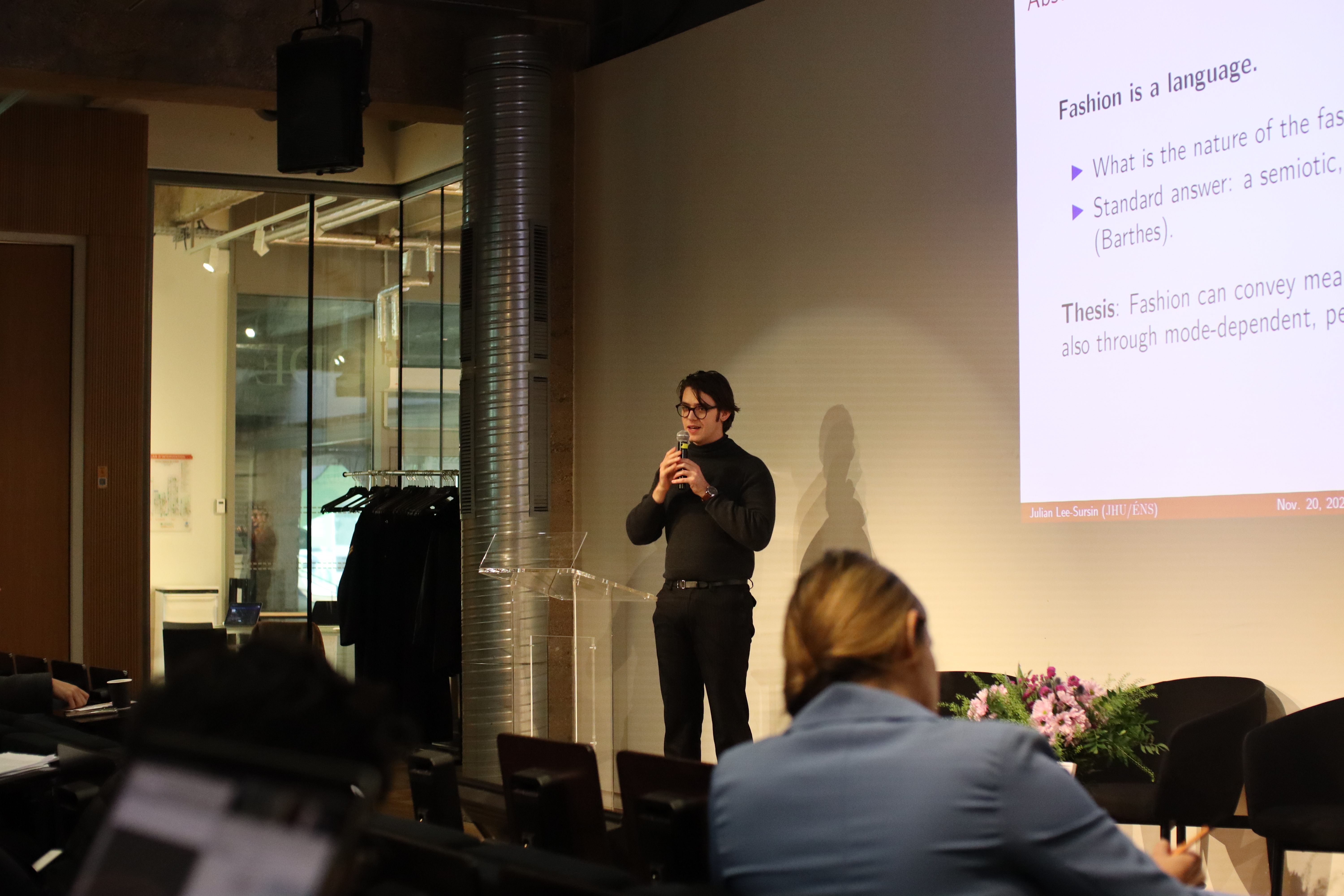
Fashion and the Jacksonian Mode: Intentionality Beyond Language — Symposium, Institut Français de la Mode, Paris (Nov 2025)
Selected Talks
(see CV for complete list)
📅 Upcoming
0- Towards an Explanatory Cognitive Model for Blackwell Informativeness* 10th International Conference on Model-Based Reasoning, Rome, Italy Jun 17–19, 2026
- Answering Why-Questions* Swedish Congress of Philosophy, Stockholm, Sweden Jun 12–14, 2026
- Fashion and the Jacksonian Mode: Intentionality Beyond Language* 17th Annual Conference of the European Society for Aesthetics (ESA), Jyväskylä, Finland Jun 8–10, 2026
- Do AI Agents Meet the Epistemic Norms for Explanation?* Inaugural Humanities of AI Workshop, Johns Hopkins University, Baltimore, MD Apr 24–26, 2026
- On Fashion's Perceptual Meaning** American Society for Aesthetics, Eastern Division, Philadelphia, PA Apr 10–11, 2026
- A Semantic Argument Against Radical Cognitivism* UF Graduate Philosophy Conference, Gainesville, FL Apr 4, 2026
No upcoming talks match your filter.
📁 Past
0- Why Presentism Precludes Explanation* Central APA, Philosophy of Time Society, Chicago, IL Feb 18, 2026
- How Causation Explains: A Semantic Inquiry* Eastern APA, Society for Philosophy of Causation, Baltimore, MD Jan 7, 2026
- Fashion and the Jacksonian Mode: Intentionality Beyond Language** Symposium, Institut Français de la Mode, Paris, France Nov 20, 2025
- Semantics for Explanation** Illinois Philosophical Association, Charleston, IL Nov 8, 2025
- Composition and Metalinguistic Negotiation† Talk for philosophy majors and faculty, Oberlin College Nov 3, 2025
- Is Acquaintance a Sui Generis Epistemic Relation?** Indiana Philosophical Association, Bloomington, IN Winner, 2025 Graduate Paper Prize Nov 1, 2025
- Semantics for Explanation** 24th University of Toronto Graduate Conference, Toronto, Canada Oct 24, 2025
- Is Acquaintance a Sui Generis Epistemic Relation?* CREPH: Mind Conference, Liège, Belgium Oct 16, 2025
- Do AI Agents Meet the Epistemic Norms for Explanation?* XVI International Ontology Congress, Basque Country, Spain Oct 9, 2025
- The Special Questions Dispute** SOPhiA, Salzburg, Austria Sep 5, 2025
- The Special Questions Dispute** 99th Joint Session of the Aristotelian and Mind Societies, Glasgow, Scotland Jul 13, 2025
- Composition and Metalinguistic Negotiation† Salvador Mascarenhas Lab Meeting, Institut Jean Nicod, Paris, France May 9, 2025
No past talks match your filter.
Affiliations
American Philosophical Association · American Society for Aesthetics · Aristotelian Society · European Society For Aesthetics · Philosophy of Time Society · Society for Philosophy of Causation · Southwestern Philosophical Society